The Heavy Rare Earth Squeeze: What's Happening in 2026.
China's export controls reshaped the game. Western players are scrambling. Here's where the market actually stands.
Heavy rare earths like dysprosium and terbium are in a supply crunch. China still controls ~90% of processing. Export controls from April 2025 remain in force. Prices are up 24–31% year-over-year. Western alternatives are coming but won't hit real scale until 2028 at the earliest. If you're in EVs, defense, or clean energy — this matters a lot.
If you follow commodity markets, you've probably heard the phrase "rare earths" thrown around a lot in the past year. But here's what often gets lost in the headlines: the real story isn't about rare earths broadly — it's specifically about the heavy rare earths.
Elements like dysprosium, terbium, holmium, and yttrium don't get the name recognition of lithium or cobalt, but they're arguably more critical. Without dysprosium, the magnets in your EV motor degrade at high temperatures. Without terbium, wind turbines lose efficiency. Without yttrium, advanced ceramics and lasers fall apart. And right now, the supply of these materials is tighter than it's been in over a decade.
Let's break down what's actually going on.
The Price Picture
Numbers first. Here's where key HREE oxides are trading as of February 2026:
| Oxide | Price ($/kg) | YoY Change |
|---|---|---|
| Dysprosium (Dy₂O₃) | ~$340 | +24% |
| Terbium (Tb₄O₇) | ~$1,010 | +31% |
| Holmium (Ho₂O₃) | ~$135 | +18% |
| Yttrium (Y₂O₃) | ~$20 | +12% |
That terbium number is striking — over a thousand dollars per kilogram, up 31% in a year. And this isn't a speculative bubble. These prices are being driven by genuine supply constraints meeting accelerating demand.
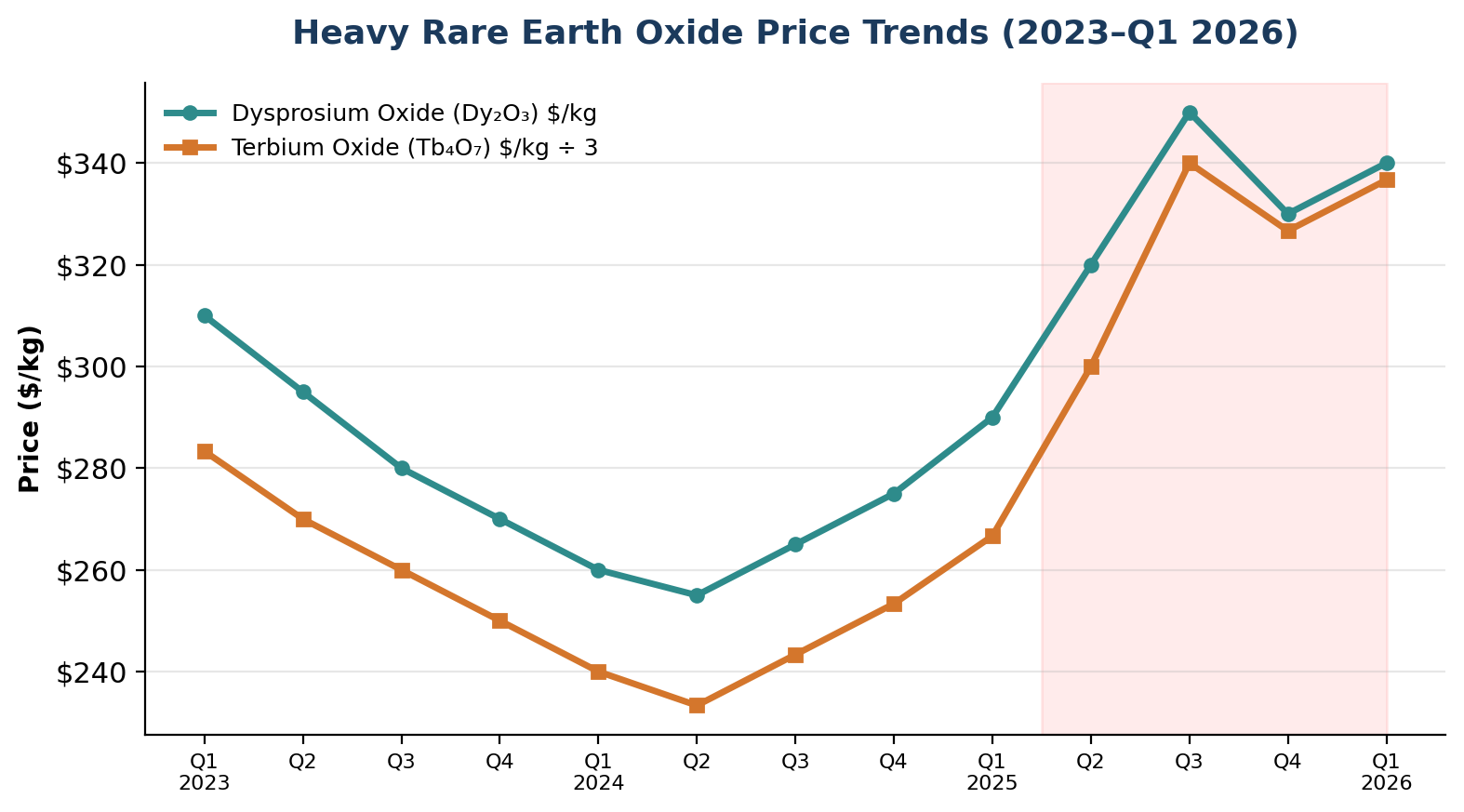
Figure 1 — HREE oxide prices from Q1 2023 through Q1 2026. The shaded region marks the onset of China's export controls.
You can see the inflection clearly in mid-2025. The rally that followed China's April export controls was sharp, and while there's been some correction as buyers paused to assess the situation, the price floor remains well above pre-control levels. This isn't going back to 2023 pricing anytime soon.
The China Factor
There's no way to talk about heavy rare earths without talking about China. The numbers are stark:
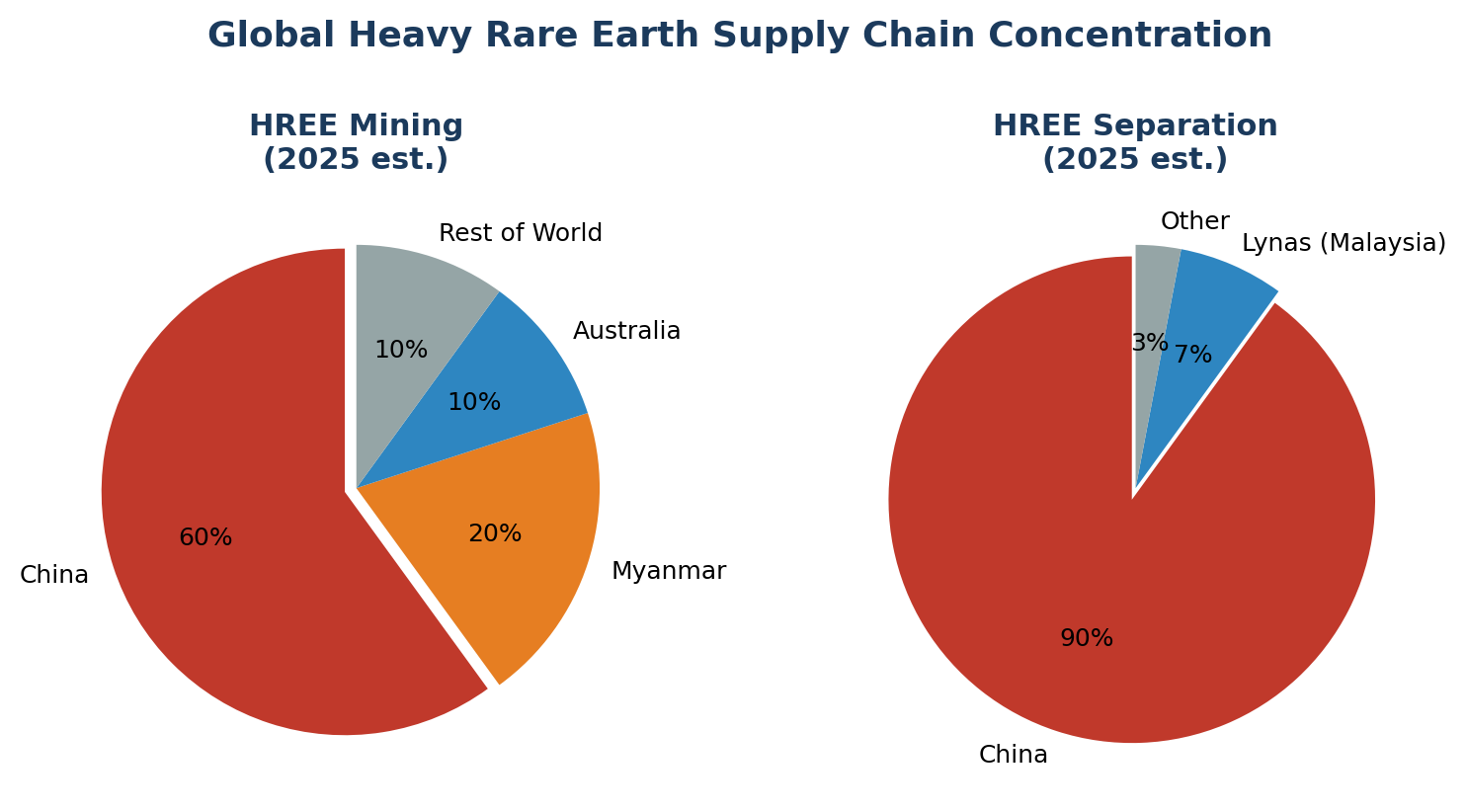
Figure 2 — China dominates both mining (60%) and, more critically, separation/processing (90%) of heavy rare earths.
That processing chart on the right is the one that should keep supply chain managers up at night. Even if you mine rare earths in Australia or Brazil, odds are overwhelming that the material gets shipped to China for separation. It's the processing bottleneck, not the mining, that gives Beijing its leverage.
And in 2025, they used it.
April 2025: China mandated export licenses for seven elements — samarium, gadolinium, terbium, dysprosium, lutetium, scandium, and yttrium — plus all their oxides, alloys, and any NdFeB magnets containing them.
October 2025: Extended controls to five more elements (holmium, erbium, thulium, europium, ytterbium) with a new extraterritorial twist — foreign companies needed licenses if their products contained even 0.1% controlled rare earth content by value.
November 2025: After the Xi–Trump summit, the October expansion was suspended for a year. But the original April controls? Still fully in force.
So we're in this odd middle ground where some controls are active, some are frozen, and everybody is watching the November 2026 clock on that suspension. It's created exactly the kind of uncertainty that markets hate.
"The seven original elements remain under active export control. The five added in October sit in regulatory limbo. Nobody's quite sure what happens next — and that's the point."
The West Is Trying — But It's a Long Road
Credit where it's due: 2025 was a milestone year for Western rare earth ambitions. Lynas Rare Earths became the first company outside China to produce commercial dysprosium oxide, at its Malaysian facility in May 2025. Terbium followed shortly after. That's genuinely historic.
But let's keep it in perspective. Lynas's total recoverable output of terbium, dysprosium, and holmium is roughly 44 tonnes per year. Global demand is measured in tens of thousands of tonnes. It's a start, not a solution.
MP Materials is making moves too — a $150 million DoD loan for heavy rare earth separation, the Independence facility in Texas coming online, and a $1.25 billion "10X" magnet campus planned for 2028 at 10,000 MT/year capacity. Iluka Resources in Australia has its Eneabba refinery targeting commissioning this year, and Arafura's Nolans Project has $840M in federal backing.
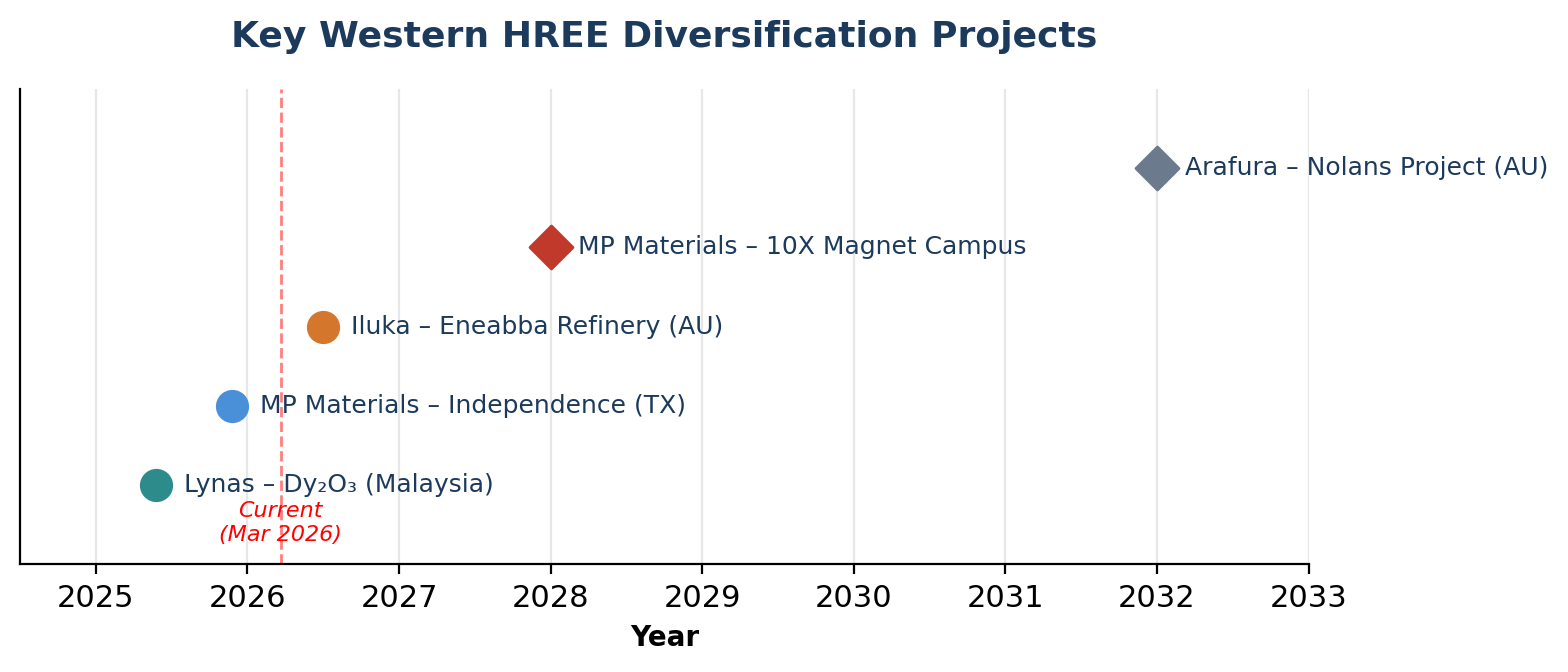
Figure 3 — Key Western projects and their timelines. Note how many are still years away from meaningful production.
The pattern is clear: lots of momentum, real capital being deployed, but the scale-up timeline means China keeps its stranglehold for at least another 3–5 years. The DFARS 252.225-7052 expansion hitting in January 2027 — requiring full mine-to-magnet provenance for all DoD procurement — will add even more urgency.
Where the Demand Is Coming From
This is the other side of the equation, and it's only growing. Global HREE demand is on track to exceed 80,000 metric tons in 2026, with three sectors doing most of the pulling:
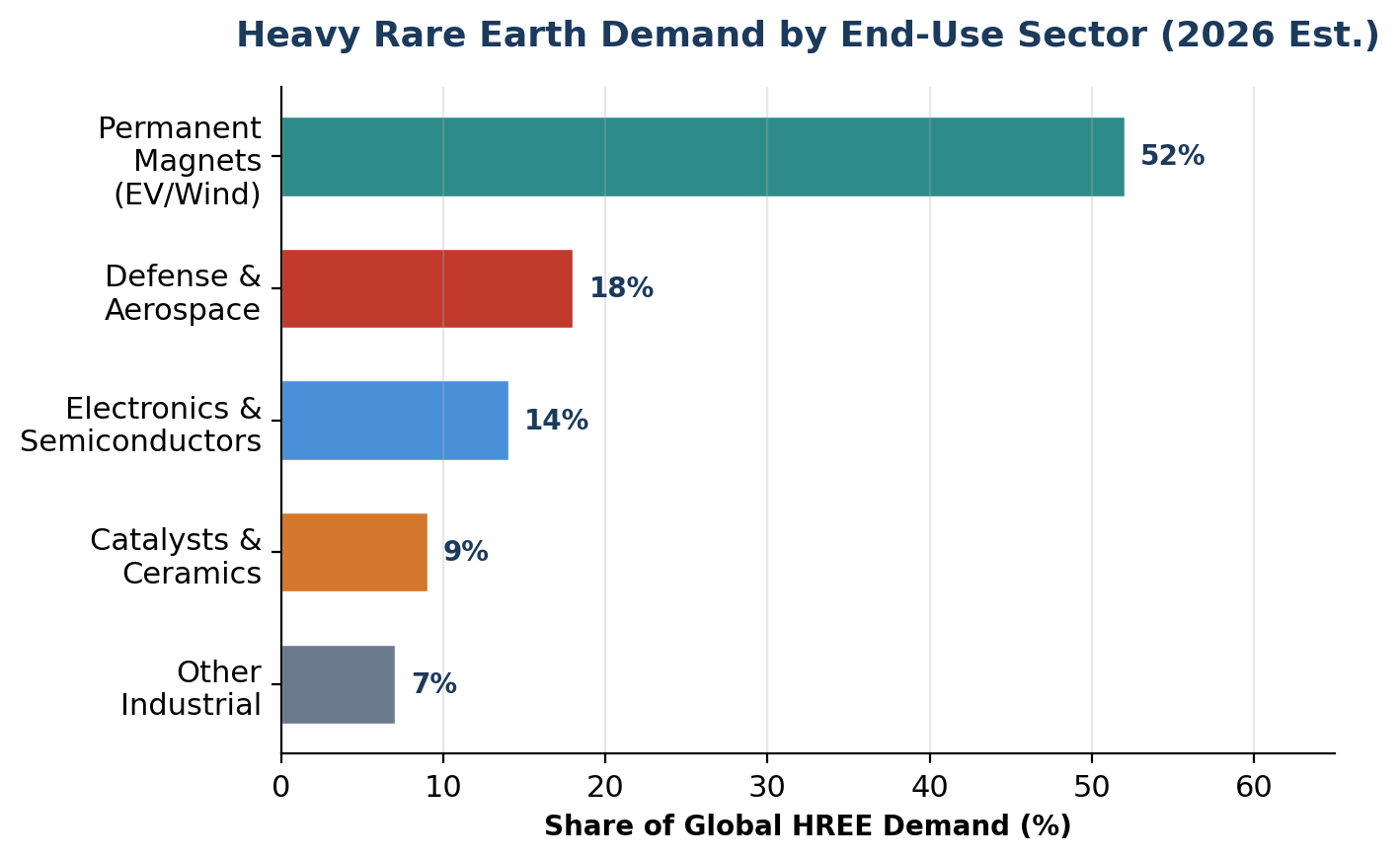
Figure 4 — Permanent magnets for EVs and wind energy account for over half of all HREE demand.
EVs and Wind Energy
Every EV needs 1–2 kg of NdFeB magnet material in its traction motor, and dysprosium and terbium are what keep those magnets working at high temperatures. The IEA projects a 25% jump in EV-related rare earth consumption this year alone. Offshore wind turbines are even hungrier — each one needs 200–300 kg of permanent magnet material.
Defense
Precision-guided munitions, radar systems, satellites, jet engines — they all depend on HREEs. With global defense budgets expanding across the US, EU, and Asia-Pacific, this demand stream isn't cyclical. It's structural and growing.
Electronics and Everything Else
Semiconductors, medical imaging, industrial automation, additive manufacturing — the long tail of HREE applications keeps getting longer. Dysprosium alone is tracking a 7.26% CAGR.
Can Recycling Help?
Short answer: eventually, but not yet. The rare earth recycling market hit $549.5 million in 2024 and is growing at 7% annually. The problem? Less than 1% of heavy rare earths are currently recycled. The technology exists in labs — recovering magnets from end-of-life electronics and machinery can cut CO₂ emissions by 61% versus primary mining — but commercial-scale HREE recycling is still nascent. Companies like Cyclic Materials are pushing new hydrometallurgical approaches, but don't expect recycling to meaningfully change the supply picture before the end of this decade.
What Comes Next
Here's how we see the range of outcomes:
EV and wind deployment outpaces supply additions. China tightens controls further. Dy₂O₃ pushes above $400/kg by year-end. Strategic stockpiling gets validated.
Global slowdown dents EV sales. China releases stockpiles or relaxes controls. BMW-style magnet-free motors gain traction. Prices correct 15–20%.
Tight balance leaning toward scarcity. Dy₂O₃ trades $300–$380/kg. Western projects inch forward but China keeps control. The Nov 2026 suspension expiry becomes the next flashpoint.
Risks Worth Watching
| Risk | Likelihood | Impact |
|---|---|---|
| China tightens controls further | Medium–High | Very High |
| Western project delays / cost overruns | High | High |
| EV demand slowdown | Medium | High |
| Magnet-free motor adoption | Low–Medium | Medium |
| Myanmar supply disruption | Medium | High |
| Recycling tech breakthrough | Low | Medium |
The Bottom Line
Heavy rare earths in 2026 are at an inflection point — but it's not the kind that resolves quickly. The structural forces are all pointing the same direction: demand is accelerating, supply is concentrated and politically fragile, and the Western alternatives that are being built won't hit real scale for another 3–5 years.
This isn't a trade. It's a multi-year theme. The key dates to watch are the November 2026 expiration of China's partial control suspension, the January 2027 DFARS provenance deadline, and whether Lynas, MP Materials, and Iluka hit their commissioning milestones. How those play out will define the HREE market for the rest of the decade.
"HREE supply risk isn't a short-term dislocation — it's a structural feature of the market that will persist through the 2020s."
Sources
- Rare Earth Exchanges — China Rare Earth Prices, Feb 2026
- MOFCOM — Announcement No.18 of 2025
- CSIS — Consequences of China's Rare Earths Export Restrictions
- IEA — Global Critical Minerals Outlook 2025
- Investing News — Rare Earths in 2026
- Rare Earth Exchanges — Mine to Magnet: Lynas and MP Materials
- Straits Research — Rare Earth Recycling Market 2025–2033
- White & Case — China Extraterritorial Rare Earth Controls
- Clark Hill — China Hits Pause on Rare-Earth Export Controls
Disclaimer: This post is for informational purposes only and doesn't constitute investment advice. Data sourced from publicly available reports and market indices. Estimates are subject to revision. Cashu Group assumes no liability for decisions made based on this analysis.